Overview
Golden Mussel Invasion
The golden mussel (Limnoperna fortunei), an invasive freshwater bivalve from Asia, was first found in North America in October 2024 in the Sacramento–San Joaquin Delta and O’Neill Forebay. More adaptable than quagga and zebra mussels, golden mussels thrive across a wider range of temperatures and salinity, attach to many surfaces, and reproduce rapidly with multiple spawning each year. Already widespread in South America and parts of Asia, their recent presence in California’s Sacramento–San Joaquin Delta and Sacramento River mark a growing threat to water systems, infrastructure, and ecological balance.
Golden mussels spread by attaching to watercraft and equipment, quickly expanding through interconnected waterways. Dense colonies deplete food sources, harm native fish, and clog infrastructure, including water delivery and energy systems, driving up maintenance and operational costs for agriculture, recreation, and public services. Without management, impacts will intensify, harmful algal blooms, restricted recreational access, and escalating costs.
To address this, California released the Golden Mussel Response Framework in April 2025. The Framework aims to prevent further introductions, contain infestations, and suppress populations to protect the environment, economy, infrastructure, and public health. Recommendations support coordinated action across agencies and jurisdictions.
On June 16, 2026 the Sacramento County Board of Supervisors declared a local emergency resulting from the invasive Golden Mussels migrating into Sacramento Waterways.
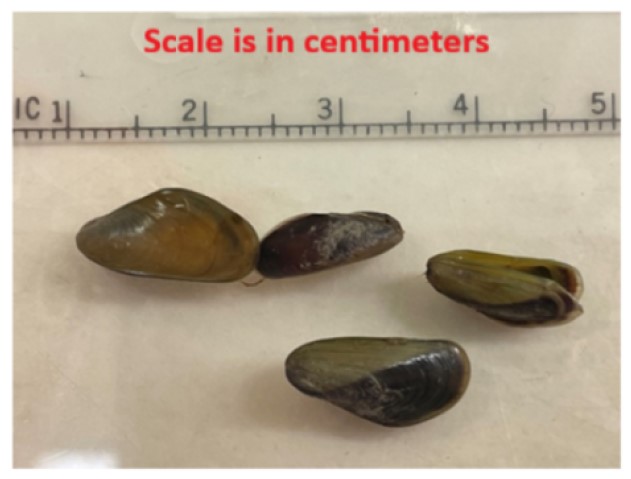
Golden Mussel shells collected in October 2024 at a water quality station at Rough and Ready Island near Stockton in San Joaquin County, California, USA. Photo: Elizabeth Wells, Ph. D. (DWR).
Earliest confirmation in Sacramento County was December 9, 2024, at Andrus Island’s southern end, followed by detection in the Sacramento River downstream of the Freeport Regional Water Authority (FRWA) intake on July 1, 2025 and most recently on June 16, 2026, while conducting invasive mussel surveys in and around the Port of West Sacramento, California Department of Fish and Wildlife (CDFW) staff identified mussels that were later confirmed to be golden mussels. Given the interconnectedness of the Sacramento River Deep Water Ship Channel and the Delta this detection was not unanticipated, however it is a significant upstream expansion of the golden mussel range that will impact public and private entities. The Sacramento County Water Agency (SCWA), supplying water to 70,000 homes and businesses, now faces potential system disruptions, increased costs, and the need for accelerated maintenance and chemical treatment. Agriculture in Sacramento County is also threatened by reduced water conveyance and potential crop losses. The threat is increasing, and a coordinated response is essential to prevent further impacts.
The potential consequences of a growing golden mussel infestation in the Sacramento–San Joaquin Delta and Sacramento River pose a serious and immediate threat to Sacramento County’s public infrastructure, environmental health, and economic stability. On June 16, 2026 the Sacramento County Board of Supervisors declared a local emergency resulting from the invasive Golden Mussels migrating into Sacramento Waterways.
During the construction of the FRWA intake facility in 2010, FRWA made contingency plans for chemical treatment of invasive mussels by installing infrastructure that can be used for the treatment of mussels. Although some chemical treatment has been identified as effective, upgrades will need to be implemented to deal with the golden mussels threat. Research is ongoing regarding the use of specialized coatings, UV Treatment, and alternative ionic solutions.
In addition, the Sacramento County Water Agency is currently monitoring for mussels weekly by conducting inspections and the routine collection of water samples at the FRWA intake. The samples are collected and sent to California Department of Fish and Wildlife to be analyzed for the DNA of golden mussels.
We will provide updates to this webpage as new information becomes available.
The California Department of Fish and Wildlife provides regular updates and announcements related to golden mussels and a map showing where new sightings have been confirmed. For more information, go to https://wildlife.ca.gov/Conservation/Invasives/Species/Golden-Mussel